Overview
SummaSoft, a platform from Aurea, set out to solve a problem that became urgent in the post-pandemic shift: distributed teams losing the sense of being a team. Slack threads and video calls keep work moving, but they don't reproduce what an office gives you for free - peripheral awareness, casual run-ins, the implicit social signal of "we're all here, working together".
The brief was a redesign of the existing platform. The goal: take a virtual office product that worked technically, and make it feel like a place people would actually choose to be - not a tool they'd be required to use.
The project ran in three phases - discovery, design, and delivery - covering desk research, user research, user flows, desktop and mobile design, 3D illustrations, and motion. The final platform shipped to production with a substantially reworked design language and feature set.
Timeline
Three-phase project: discovery, design, and delivery (2022).Background
SummaSoft was a working virtual office platform when the project started - the redesign focused on making it feel like a place rather than a tool. I led the project as Senior Product Designer and Design Lead, working alongside a Product Designer, a Project Manager, and an Illustrator.
Role
Senior Product Designer
Design Lead
Expertise
Product Design
Visual Direction
Team Leadership
Year
2022

Process
The work was about positioning a strange product category - not skeuomorphic enough to feel like a videogame, not flat enough to feel like a SaaS dashboard. The metaphor needed to do real work - give people a sense of place - without pretending to be something it wasn't. Four threads ran through every screen: strategic positioning, visual direction, legibility of the space, and team leadership.
Strategy first, screens second
The early strategic work was about positioning the product on the spectrum between physical office and SaaS dashboard. Not skeuomorphic. Not flat. The metaphor had to do real work - give people a sense of place - without pretending to be something it wasn't.Visual direction as a feature, not a finish
Most enterprise tools treat visual design as the layer applied at the end. For a virtual office, the visual language is the product. I led visual direction across the team - partnering with the illustrator on 3D office renderings, with the product designer on UI states. The brief I held the team to: every screen should answer "would I want to spend my workday here?" before "does this feature work?".Flows that make the space legible
Virtual offices have a discoverability problem. Users don't know what's available, where to go, or how to behave socially. The user flow work focused on making the space legible without being explained: where rooms are, who's in them, what's appropriate to do there, how to start a conversation without it feeling like an interruption.Leading the team, not just the design
As Design Lead, I made a deliberate choice to give the team real space to own work end-to-end - including presenting to the client and making design decisions without me as a gate. My job was to set the strategic direction and the quality bar, then trust the team to clear it.

Outcome
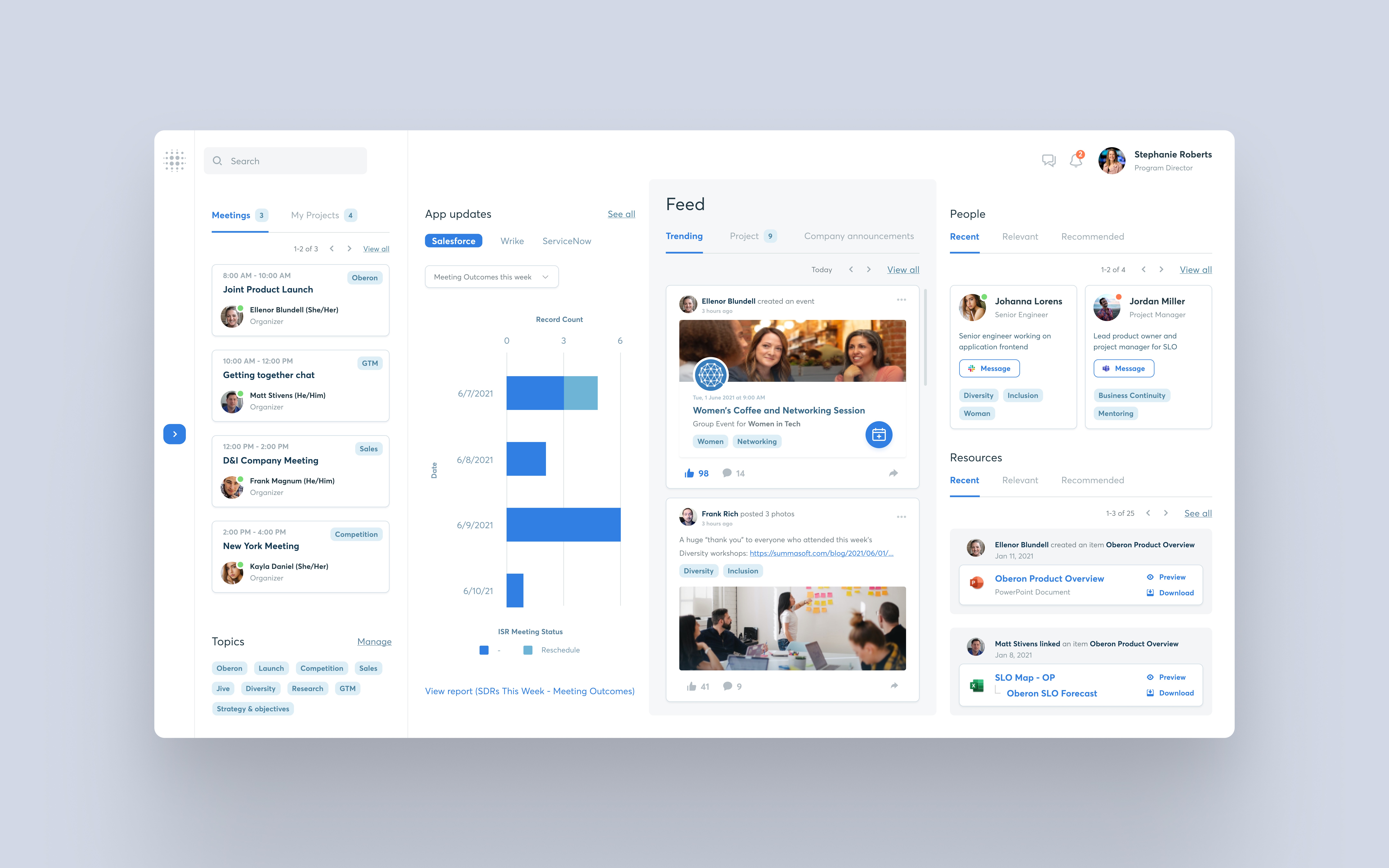
The redesign shipped to production. SummaSoft's platform now reflects a substantially different design language - one that leads with a sense of place, with collaboration features that compose into a recognizable spatial experience rather than a list of disconnected tools.
Strategic Product Leadership
The project was a step into more strategic product leadership: setting visual direction, making the case for design decisions to clients, and trusting a team to deliver against a clear quality bar.Production Outcome
The platform shipped with a reworked design language and feature set, integrating spatial design, 3D illustrations, and cross-platform parity between desktop and mobile.
What this case demonstrates
Leading product design end-to-end on a complex cross-platform project, from discovery to delivery
Setting and defending visual direction as a strategic lever, not a decorative layer
Translating an abstract product category ("virtual office") into a concrete, usable spatial experience
Leading a small product team while creating space for individual contributors to grow into more senior work
Working directly with clients to align strategic direction, present design decisions, and defend trade-offs